How to Achieve Hominess
How to Achieve Hominess

So, what features make an environment feel homey?
Our survey results revealed that:
Physical comfort was rated highest in importance for making participants feel at home in any environment. All participants rated physical comfort as at least “moderately important".”
Familiarity with the space, the ability to modify one’s environment, and a sense of privacy were also rated as “very important” to feeling at home in any environment.
Objects that reflect memories and values were rated as being the “least important” in making participants feel at home, with an average moderate rating.
The Three Key Affordances

Hominess in the workplace is achieved through the interaction between people and their work environments. In other words, “hominess” is an action. To support people’s action, the environment must have a set of affordances that enable hominess. We identified familiarity, trust, and a sense of ownership as three key affordances that a workplace must have to achieve hominess. Each characteristic has a concrete spatial manifestation that can be integrated into workplace design.
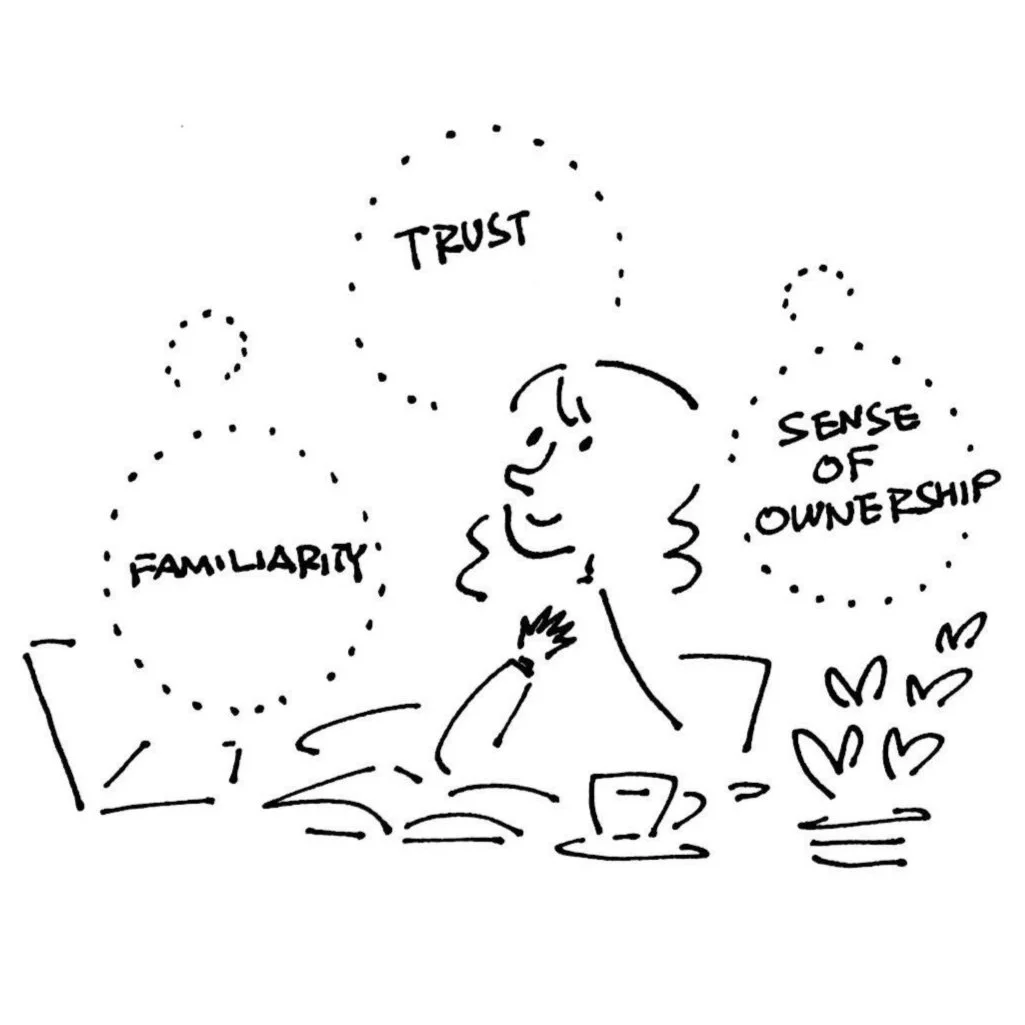
Familiarity
“People can feel that something is theirs by virtue of being associated and familiar with it.”
Familiarity is the gateway to hominess, as it allows people to feel that they intimately know the space and feel physically and emotionally comfortable in it. Familiarity captures a holistic interaction between the ambiance, the visual aesthetics, and the ritualistic behaviors that people see, feel, and do in their workplace. We identified five spatial strategies to improve familiarity:
-
Humans have an innate connection to nature. Incorporating biophilic components into workplace design is a way to restore that familiarity with nature, which is an important avenue to hominess. Biophilic components can be achieved by incorporating natural or nature-inspired materials, inserting nature into indoor environments through plants and water features, and creating a nature-like ambiance through daylight, fresh air, and views of outdoor nature. View our Case Study here.
-
Warmth refers to the physical and emotional aspects of the space. Physically, warm colors and lighting, soft textures, and ambient music can create a warm ambiance in the space. Emotionally, relationships with the people one interacts with can enhance warm feelings and connections. View our Case Study here.
-
Shared personalization is a means to celebrate the common identity and interest of employees. Employ shared personalization by adding decorations that resonate with the community, showcasing projects and achievements, or adding playful objects that enhance the character of the space. View our Case Study here.
-
Micro breaks are short, frequent respites that help reduce fatigue and improve focus and productivity. They can take many forms, such as walking, stretching, deep breathing, snacking, etc. Being able to take micro breaks is important, especially when workers can access them as simply and easily as they do at home. A key factor to the success of micro breaks is employee's’ proximity to tools, resources, and conveniences. View our Case Study here.
-
When workers are not anchored to a specific location in an office, legibility is critical to ensure that workers can navigate and use the space efficiently. Office design must be intuitive, easy to navigate, organized, clean, and have clear functionality to prevent feeling lost in the space. View our Case Study here.
Trust

A sense of trust in the space can influence one’s decision to actually come in and use the office, which is the first hurdle on the path to hominess. If workers do not trust that the office will support their physical and emotional safety, comfort, and productivity, they might not want to come to the office to work frequently. We identified two characteristics of trusted office environments:
-
Feeling safe in the office can be predicated on physical attributes like being able to securely store one’s valuables or emotional attributes like feeling that one belongs to the community. Key tools for an office’s “Safety Toolbox” may include providing personal lockers, incorporating subtle visual boundaries, and strategically placing social nooks/nodes. Physical safety is feeling safe when leaving valuable items during micro-breaks and/or over an extended period, when engaging fully in tasks without always being alert to the surroundings. In contrast, emotional safety is feeling safe to be one’s authentic self and to express thoughts, feelings, and concerns without fear of judgment, ridicule, or retaliation. View our Case Study here.
-
Reliability relates to access to basic needs such as physical comfort, reliable technology (e.g., Wi-Fi, monitors, power), access to nutrition, and other tools and resources that support comfort and privacy. For an office to be reliable, it must consistently support workers' needs. View our Case Study here.
Sense of Ownership
“The roots of psychological ownership can be found in three main motives: (1) efficacy and effectance, (2) self-identity, and (3) 'having a place.'”

A sense of ownership in a free-address environment does not necessarily mean being able to own a specific part of the office. Instead, it is a feeling enabled by the office design, culture, and policy to choose, claim, and personalize part or all of the spaces and objects in the office. We found the ability to achieve a sense of ownership to align with Patel and Angne Alfaro’s (2021) roots in psychological ownership, which consists of three elements: efficacy, self-identity, and having a place. The ability to choose can happen when there are enough choices available, so one feels they have the agency to choose based on their needs and preferences. Ability to claim is about actively asserting one’s presence in a space, in a free-address office, for a period of time. Lastly and arguably the most important is the ability to personalize so one can express their self-identity. This last aspect of a sense of ownership can be challenging in the free-address model, but it is not impossible. Through proper policy planning and culture, it is possible to personalize the environment to meet employees’ unique identities.
-
The ability to choose can happen when there are a variety of options available, so one feels they have the agency to choose based on their needs and preferences. A “variety of options” refers to a diverse and accessible selection of spatial zones and furniture types/sizes for employees to exercise a sense of control over. View our Case Study here.
-
The ability to claim is about actively asserting one’s presence in a space, such as a free-address office, for some period of time. It can be a physical action like leaving one’s belongings or a desk tag to “claim” a workstation as one's own or using a reservation system to “have a place” for a predetermined time period. View our Case Study here.
-
The ability to personalize allows someone to adjust their work environment to match their needs and preferences (self-identify). Through proper design, policy planning, and culture, it is possible to personalize the environment to meet employees’ unique identities. Examples of quickly implementable and customizable design features may include occupant-controlled lighting/temperature/noise, etc., height adjustable desks and chairs, and modular components. View our Case Study here.